
New York City, New York HOA Fee Calculator 2026
New York is the most expensive association market in America, and it is not close. The median HOA or condominium fee actually paid across the New York metro area is $605 per month (U.S. Census Bureau, ACS 2025, margin of error ±$18) — and across New York State it is $809, the highest state figure in the country. In Manhattan and brownstone Brooklyn the monthly number is only half the story: co-op maintenance bundles property taxes and building staff into one charge, condo common charges sit alongside separate tax bills, and Local Law 97 has added a decarbonisation bill that buildings are only beginning to pass through.
Average HOA Fees in New York City by Neighborhood Type
| Property Type | Average Monthly Fee | Annual Cost | What's Included |
|---|---|---|---|
| Manhattan Co-op (Full-Service) | $1,450/mo | $17,400/yr | Doorman and staff, elevator, underlying mortgage share, property taxes included in maintenance, heat and hot water |
| Manhattan / Brooklyn Condo | $925/mo | $11,100/yr | Common charges only — property taxes billed separately; staff, amenities, reserves |
| Brooklyn / Queens Mid-Rise Condo | $640/mo | $7,680/yr | Elevator, part-time staff or virtual doorman, common utilities, reserves |
| Outer-Borough / Garden Complex | $410/mo | $4,920/yr | Grounds, parking, exterior maintenance, master insurance |
| Suburban Single-Family HOA (Metro) | $365/mo | $4,380/yr | Clubhouse and pool, gates, common landscaping — no building services |
What Do HOA Fees Cover in New York City?
In a New York condo, common charges cover the building's operating budget: staff (the dominant cost in doorman buildings), elevator contracts, common-area utilities, master insurance, management, and contributions to the reserve fund for capital work — façade and Local Law 11 cycles, roof, boiler and elevator modernisation. In a co-op, the single monthly maintenance charge covers all of that plus the building's property taxes and its share of any underlying mortgage on the building, which is why co-op maintenance figures look dramatically higher than condo charges for similar apartments: they are not buying the same basket.
What neither charge covers: your unit's interior, your own mortgage, and (for condos) your property tax bill, which arrives separately and is frequently as large as the common charges themselves. Sponsor- and investor-owned units, flip taxes on resale in many co-ops, and working-capital contributions at purchase sit outside the monthly figure entirely.
What Drives HOA Fees Higher in New York City?
Labour first: New York buildings run on unionised staff — doormen, porters, supers, handymen — under contracts from SEIU 32BJ and the Realty Advisory Board, and every contract round reprices every full-service building in the city at once. Second, the regulatory stack: Local Law 11 façade inspection and repair cycles, Local Law 97 emissions limits with fines from 2025 onward, elevator and boiler codes, and Local Law 126 parking-structure inspections each arrive as capital programmes measured in millions per building. Third, insurance and energy: master policy premiums and Con Edison steam and electric rates have risen steeply. Fourth, age: the pre-war stock that defines Manhattan and Brooklyn carries elevators, boilers and façades that are a century into their service lives.
How Much Are HOA Fees in New York City?
Start with the Census reality: half of fee-paying households in the metro area pay more than $605 a month. Within the city, the table above is the working map — full-service Manhattan co-ops at the top, garden complexes in the outer boroughs at the bottom. Two adjustments matter more than any neighbourhood label. A co-op's maintenance must be reduced by the property-tax portion (often a third or more) before comparing it with a condo's common charges. And any building facing a Local Law 97 retrofit or a façade programme should be priced on its post-project charges, which the board can usually estimate — ask for the capital plan, not just the current budget.
Are HOA Fees Negotiable in New York City?
Monthly charges are not negotiable — they are set by the budget and your unit's allocation (in condos, the common interest percentage in the declaration; in co-ops, your share count). What is negotiable sits around the edges: in a purchase, closing adjustments, who pays any flip tax (co-ops commonly charge sellers 1–3 percent, where the bylaws impose one), and arrears the seller must clear to deliver the unit. Sponsors selling new-development units sometimes offer charge abatements for a period; read whether the abated amount is repaid later through the budget — it usually is, by everyone.
Do HOA Fees Go Up Every Year?
Yes — structurally. Staff contracts, insurance and energy all escalate, and the capital cycle (façades every five years under Local Law 11, Local Law 97 retrofits through 2030 and beyond) is layered on top. Boards that held charges flat through the 2010s are now funding reserves under pressure from lenders and insurers, the same pattern visible nationally. A realistic planning assumption for a New York building is annual increases in the mid-single digits, with step jumps in capital-project years; our Local Law 97 guide explains the largest single new driver.
New York HOA Laws: What New York City Buyers Should Know
New York condominiums are governed by the Condominium Act, Real Property Law Article 9-B (§ 339 et seq.): the board of managers sets common charges, holds a lien for unpaid charges with a defined priority, and must provide financial statements to owners. Co-ops are corporations under the Business Corporation Law — shareholders elect the board, and the proprietary lease, not a declaration, is the governing document. Both forms must comply with the city's overlay: Local Law 11 (façade inspections), Local Law 97 (emissions), Local Law 126 (parking garages) and the Housing Stability and Tenant Protection rules where rentals are involved. The New York state guide covers the statewide picture, including the $809 median.
How to Estimate Your Total Cost of Owning an HOA Home in New York City
Budget a New York purchase on four lines, not two: mortgage, monthly charges, property taxes (separate for condos, embedded for co-ops), and a realistic allowance for assessments. A $850,000 condo with $925 common charges and $950 monthly taxes carries $1,875 a month before the mortgage is mentioned — which is why lenders underwrite New York co-ops and condos on the full carrying cost, and why boards review buyers' finances in the first place. The calculator below projects the charges line over your holding period at the growth rate you choose; stress it at 5 percent before you fall in love with the apartment.
Calculate Your Future HOA Costs
Use the free HOA Fee Calculator to project this fee over 5 to 30 years — or compare three fee futures side by side with the Scenario Calculator.
How New York City compares
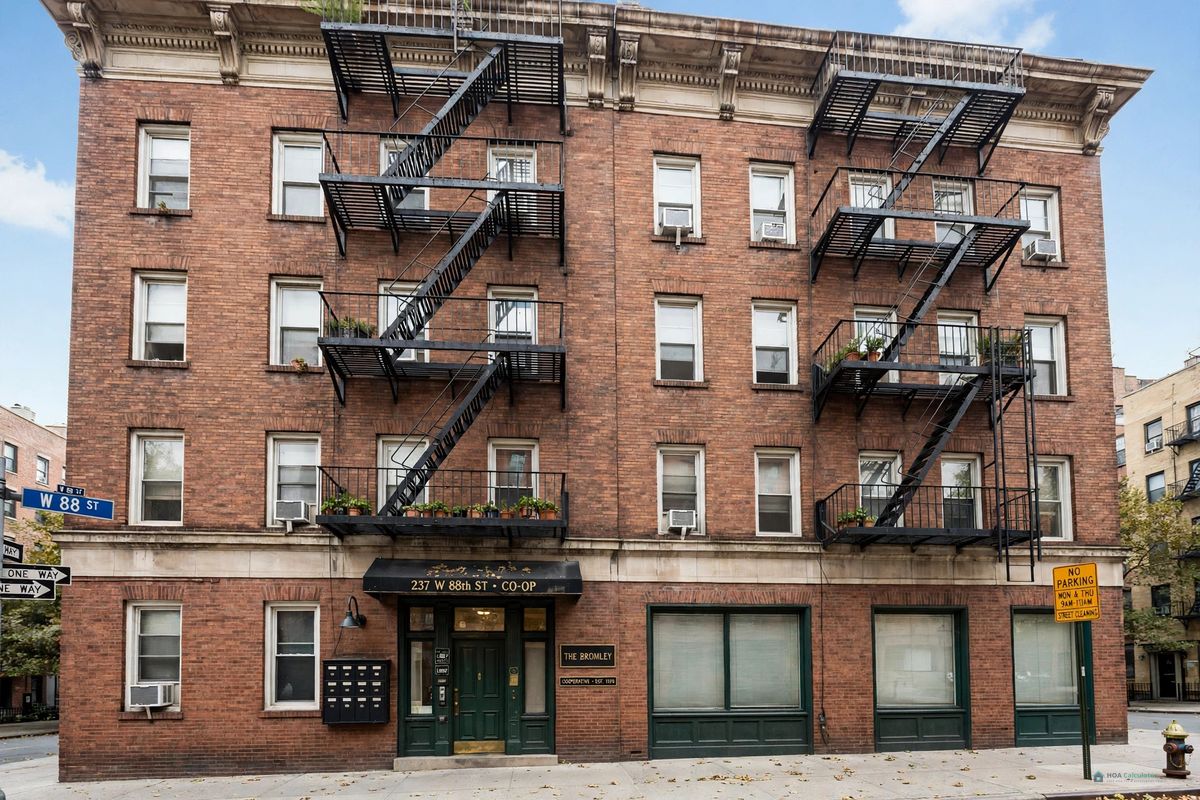
For context, the median HOA or condominium fee actually paid across New York State is $809 per month (U.S. Census Bureau, ACS 2025) — the state figure exceeds the metro figure because it captures the city's full-service stock at full weight. Against the other large metros tracked on this site, New York's $605 metro median stands alone: Boston follows at $392, Chicago at $260, Miami at $438 and Los Angeles at $350. The gap is the staff-and-regulation model described above; no other American market bundles this much labour and compliance into a monthly charge.
The practical consequence for movers: a household relocating from Chicago or Boston to New York should not scale its old fee by the rent ratio — association charges here run two to three times those metros at the median, and the co-op tax bundling means the comparison must be rebuilt from the budget documents, not estimated.
Frequently Asked Questions (FAQs)
What is the average HOA fee in New York City?+
Why is co-op maintenance higher than condo common charges?+
What is a flip tax?+
How does Local Law 97 affect my charges?+
Can a New York condo or co-op foreclose for unpaid charges?+
Do New York buildings let buyers see finances before purchase?+
Looking for Full Multi-Property Comparisons?
Use our advanced homepage comparison engine to pit multiple properties, tax rates, and fee structures against each other.
← Open Home Page Calculator