
Can Your HOA Ban Your Airbnb? Short-Term Rental Rules, Fines and Your Options
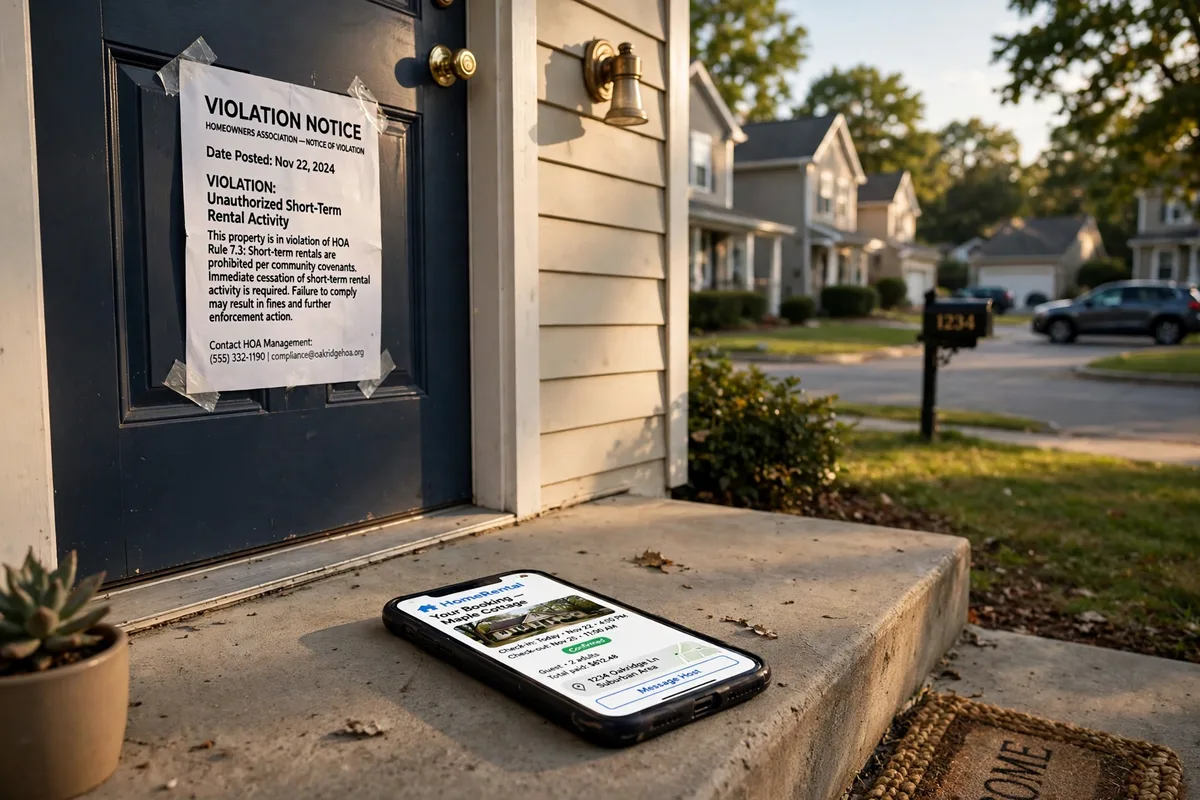
The letter usually arrives after the bookings do.
Can an HOA legally ban Airbnb and other short-term rentals?
You listed the spare house in March. The city said fine — you have a permit, you pay the local lodging tax, guests come and go. Then a letter from your HOA's management company lands in the mailbox: short-term rentals violate the community's covenants, the listing must come down, and fines start at $100 a day until it does.
Your first thought is the permit. The city approved this. Surely that settles it? It doesn't. And that gap — between what your city allows and what your HOA allows — is where owners lose real money every month.
In most cases, yes. An HOA's power over rentals doesn't come from the city or the state. It comes from the CC&Rs — the Covenants, Conditions and Restrictions recorded against your deed when you bought. That's a private contract, and courts in most states have upheld rental bans that are written into it clearly and enforced the same way for everyone.
The restrictions come in a few common shapes:
- A full ban on rentals under a set number of days — 30 days is the usual line.
- A minimum lease term of 30, 60, 90 or even 180+ days, which kills short stays without ever naming Airbnb.
- A rental cap — only a fixed percentage of homes in the community may be rented at once, with a waiting list behind it.
- A platform ban — the documents name Airbnb, Vrbo and similar services directly.
The rule you need is in your own documents, not in a neighbour's opinion of them. Boards also pass rules and resolutions on top of the CC&Rs, so ask for those too — and read up on how HOA rules enforcement actually works before you assume a rule on paper is a rule in practice.
Why doesn't your city permit or your state law protect you?
Because they're separate tracks, and you have to satisfy both at the same time.
State preemption laws are the big source of false confidence here. Arizona's A.R.S. § 9-500.39 stops cities and towns from banning short-term rentals. Idaho's HB 583 and Indiana's HEA 1210, both effective July 1, 2026, do the same job in those states. Owners read those headlines and assume they're covered.
They aren't. Those laws bind governments. Your HOA is not a government — it's a private contract you signed at closing. As the Central Arizona Association of Realtors puts it, state law prevents government prohibition but does not give owners the right to ignore private restrictions. A valid city STR permit does not override an HOA ban, and an HOA ban does not need a city ordinance behind it.
What counts as a "short-term" rental in HOA documents?
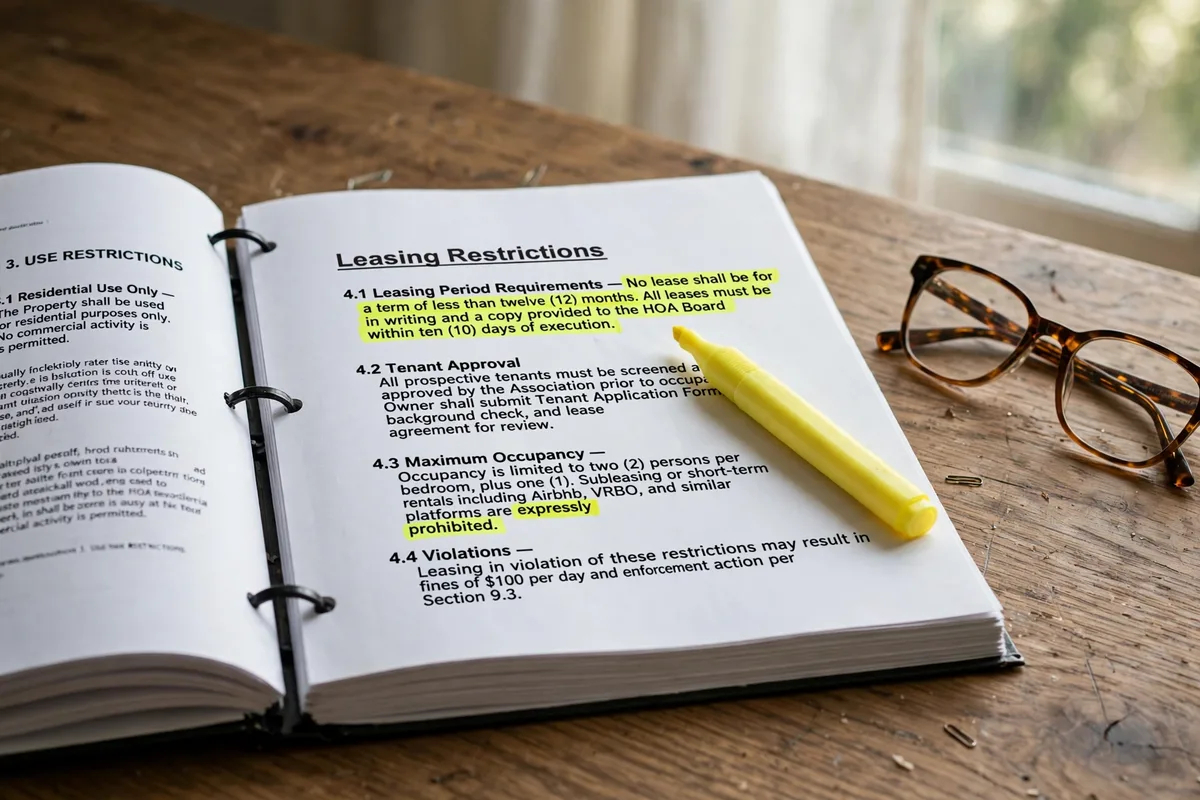
Most communities draw the line at 30 days: a rental shorter than that is short-term, anything longer is a normal lease. Some declarations set the minimum at 6 or 12 months for the first year of ownership — a clause aimed squarely at investor buyers.
Watch the wording, because boards write it differently:
- "No lease for a term of less than 30 days" — a minimum-stay rule.
- "No transient or hotel-like use" — older language that boards now apply to Airbnb stays.
- "No portion of the home may be rented" — blocks the spare-room listing some owners assume is safe.
- "Owner must occupy the home for 12 months before leasing" — you can't rent at all in year one.
If the language is old and vague, that cuts both ways. Boards can amend it — which brings us to the money.
What actually happens if you rent anyway?
This is the part the investor blogs describe as "risk" and owners experience as a bill.
Daily fines. Fines for rental violations commonly run $100–$500 per day until the listing comes down. In Florida, associations can fine up to $100 per violation per day, capped at $1,000 in total per violation, under Florida Statutes §720.306(1)(h) for HOAs and §718.110(13) for condos. Thirty days of ignoring the letter in another state, at $250 a day, is $7,500 — before anything else happens.
Liens. Unpaid fines and assessments can become a lien on your home. A recorded lien has to be cleared before you can sell or refinance, which is why a "small" rental dispute surfaces years later at the worst possible moment — mid-sale, in the estoppel letter your buyer requests.
Legal-cost assessments. When an owner fights and loses, some associations assess the cost of the fight back to the unit. One STR advocacy source puts hosts' legal costs in contested cases at over $50,000 — treat that as an advocacy figure, but the direction is right: the meter runs on both sides, and the association spends money collected from every owner, including you.
Amenity suspension and injunctions. Boards can cut access to the pool, gym and clubhouse, and can ask a court for an injunction that shuts the listing down by order rather than by fine.
How do you check the rules before you buy or list?
Do this before the listing goes up, not after the letter arrives. It's the same document discipline as reading an HOA budget before closing, applied to one clause:
- 1. Get the full CC&Rs, plus every amendment. Amendments matter — a ban adopted in 2023 won't be in the copy recorded in 2009. Ask the management company for the complete set, in writing.
- 2. Find the leasing section. Search for "lease", "rental", "transient", "hotel" and "30 days". Note the minimum term, any rental cap, and whether there's a waiting list.
- 3. Check the adoption date against your purchase date. Restrictions adopted after you bought are the ones with grandfathering fights around them. Some states and some declarations protect existing owners; many don't. This is the clause a local real-estate attorney earns their fee on.
- 4. Ask about enforcement, not just rules. A cap that is full, with six owners waiting, is a ban in practice. Board minutes from the last year show whether STR enforcement is active or dormant.
5. Run the numbers before you count the income. If the home only works as an investment with short stays, and the documents say 30-day minimums, the deal doesn't work. Our HOA fee calculator can show what the dues side of the property costs you while you decide.
Can a rental ban be changed — or challenged?
Sometimes, but slowly.
Amending the CC&Rs typically needs a supermajority vote — usually 67–75% of all homeowners, not just of those who show up. That is a high bar in a community where most owners bought precisely because they didn't want a rental next door.
Challenges do happen on narrower grounds: the ban wasn't adopted following the declaration's own amendment procedure, enforcement is selective (the board president's cousin rents freely), or your purchase predates the ban and your state protects vested rights. Those are fact-specific arguments. They are attorney territory, and they get more expensive the longer daily fines stack up underneath them.
What should you do if the fine letter is already in your hand?
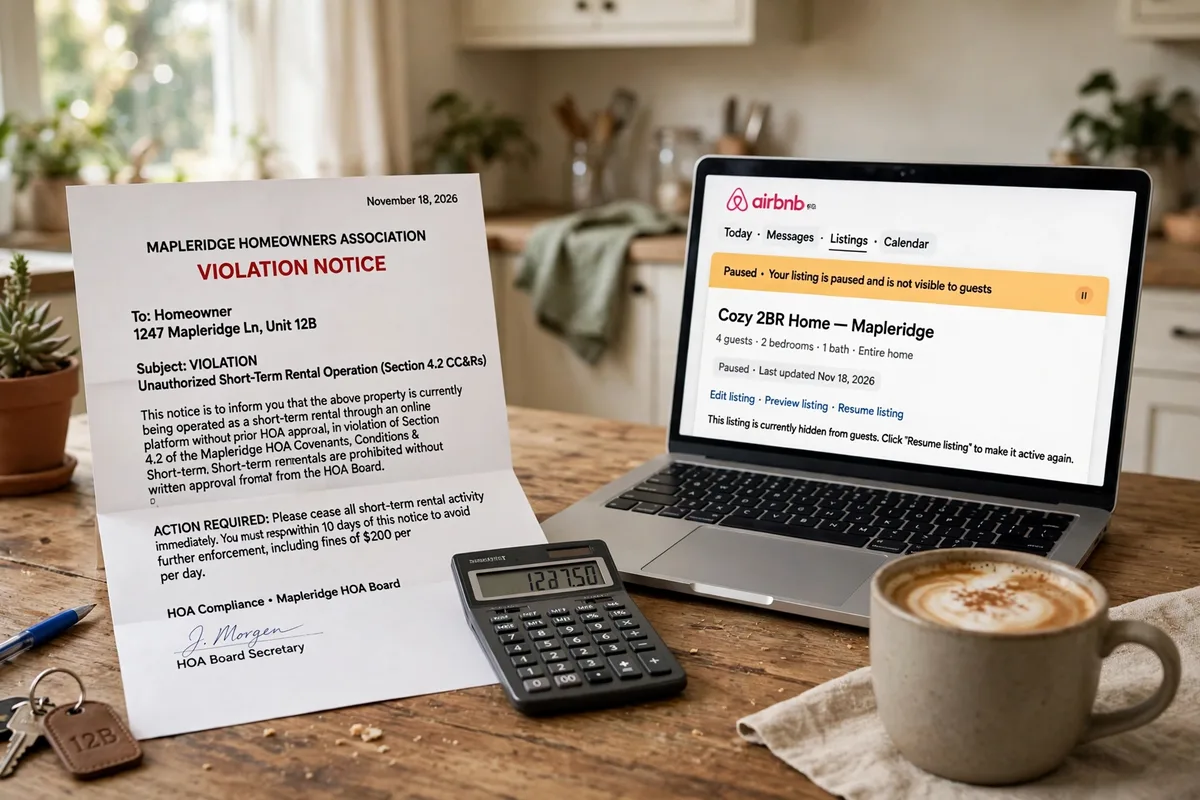
- Stop the daily bleed first. Pause or delist while you sort it out. Every day of argument is another day of fines in most documents.
- Ask for the exact clause. The letter should cite the section of the CC&Rs or rules you're accused of breaking. If it doesn't, request it in writing.
- Check your dates. When was the restriction adopted? When did you buy? When did you start renting? That timeline decides whether grandfathering is even worth discussing.
- Use your hearing rights. Most states and most documents give you a hearing before fines are final. Take it, bring the timeline, and keep it boring and factual.
- Then decide with real numbers. Attorney's opinion vs. the fine total vs. switching to 30-day-plus stays. Plenty of owners land on mid-term rentals to travelling nurses and relocating families — legal under a 30-day rule, and often steadier income anyway.
About the author: Mehr Farooq runs HOA Fee Calculator, where she reads association budgets, fee schedules and governing documents and turns them into plain-English guides and calculators for owners. Sources for this article: fine ranges and amendment thresholds (AirROI's HOA restrictions guide), Florida fine caps (Florida Statutes §720.306(1)(h) and §718.110(13), via StaySTRA), the 30-day definition (PropertyFocus), and 2026 preemption laws in Idaho and Indiana (Revenuenaire). This article is general information, not legal advice — your own CC&Rs and state law decide your case.
Frequently Asked Questions
Q: Can my HOA ban Airbnb if my city allows short-term rentals?
Yes. The city permit and the HOA covenants are separate tracks. A permit satisfies the government; it does nothing about the private contract in your CC&Rs, and you have to comply with both.
Q: How much can an HOA fine me for an illegal short-term rental?
It depends on your documents and your state. Typical daily fines run $100–$500. In Florida the statutory ceiling is $100 per day per violation, capped at $1,000 total per violation, under §720.306(1)(h) (HOAs) and §718.110(13) (condos).
Q: I bought before the rental ban was adopted. Am I grandfathered in?
Maybe — it depends on your state's law and your declaration's amendment clause. Some owners are protected; many are not. Because daily fines can run while you argue, get a local attorney to read your documents before you rely on grandfathering.
Q: Does a 30-day minimum stay rule really ban Airbnb?
In practice, yes for holiday stays. It doesn't ban renting — it bans short renting. Owners who need rental income often switch to 30-day-plus stays for travelling professionals instead.
Q: Can the HOA put a lien on my home over rental fines?
In many states, yes — unpaid fines and assessments can become a lien, and it must be cleared before a sale or refinance. Rules vary by state and by document, which is why the estoppel letter at closing is where old disputes resurface.
📊 Calculate Your HOA Costs
Use our free HOA Fee Calculator to estimate your true lifetime HOA expenses — with year-by-year breakdown.
Calculate Now →