
District of Columbia HOA Fee Calculator & Guide 2026
Thinking about buying in the District of Columbia? Here's what you need to know about local condo and HOA laws, average costs, and how to avoid overpaying.
HOA Fees by Neighbourhood in the District of Columbia
| Neighbourhood | Estimated Average HOA Fee Range |
|---|---|
| Capitol Hill | $450 - $800/mo |
| Georgetown | $500 - $950/mo |
| Dupont Circle | $475 - $900/mo |
| Adams Morgan | $425 - $800/mo |
| Navy Yard | $400 - $750/mo |
District of Columbia HOA & Condo Laws You Must Know
The District packs its associations into 68 square miles, and most of them are not suburban HOAs at all. The typical DC association is a condominium or co-operative building — a pre-war walk-up in Adams Morgan, a staffed tower in the West End, a converted rowhouse in Capitol Hill — where the fee buys staff, elevators, boilers and parking rather than lawns and gates. A minority of communities, mostly in the District's outer neighbourhoods, are single-family homeowners associations run under recorded covenants.
In the District of Columbia, condominiums are governed by a specific statute — the DC Condominium Act — while homeowners associations rest on their declarations and general nonprofit law (compare these rules with our 50-state analysis of HOA laws by state and nationwide average HOA fees by state). It's critical to understand which regime your building sits under before you sign on the dotted line.
Transparency works differently under each regime. The Condominium Act gives unit owners rights to financial records and open board meetings; in a declaration-governed HOA, your access rights are whatever the documents and the Nonprofit Corporation Act give you — which makes reading the resale packet the single most important step in a DC purchase.
- Condominiums are governed by the District of Columbia Condominium Act, D.C. Code §§ 42-1901.01 et seq., which covers assessments, meetings, records and the association's enforcement powers.
- A condominium association holds a statutory lien for unpaid assessments (§ 42-1903.13), and the last six months of assessments take priority over a first mortgage; the lien can be foreclosed.
- On resale, sellers must deliver the disclosure packet required by § 42-1904.11 — account statement, declaration, bylaws, rules and budget — and buyers get a cancellation window after receiving it.
- Homeowners associations have no dedicated DC statute: assessment caps, fine powers and voting rules come from the recorded declaration, so two DC HOAs on the same street can operate under entirely different rules.
The $475 Fee That Became $690
A buyer purchased a one-bedroom condominium near Eastern Market with a quoted monthly fee of $475. Eight months later the board passed a special assessment for elevator modernisation and garage structural repairs — $7,740 per unit, collected at $215 per month over 36 months.
District buyers should ask for the reserve study and the list of planned capital projects inside the § 42-1904.11 resale packet — and use the cancellation window if the answers are missing.
Average HOA Fees by State: The Complete 2026 Ranking
See where the District's $490 median sits against all 50 states — and why New York's $809 is the only state figure above it.
Calculate Your Future HOA Costs
Use the free HOA Fee Calculator to project this fee over 5 to 30 years — or compare three fee futures side by side with the Scenario Calculator.
HOAs in the District of Columbia by the numbers
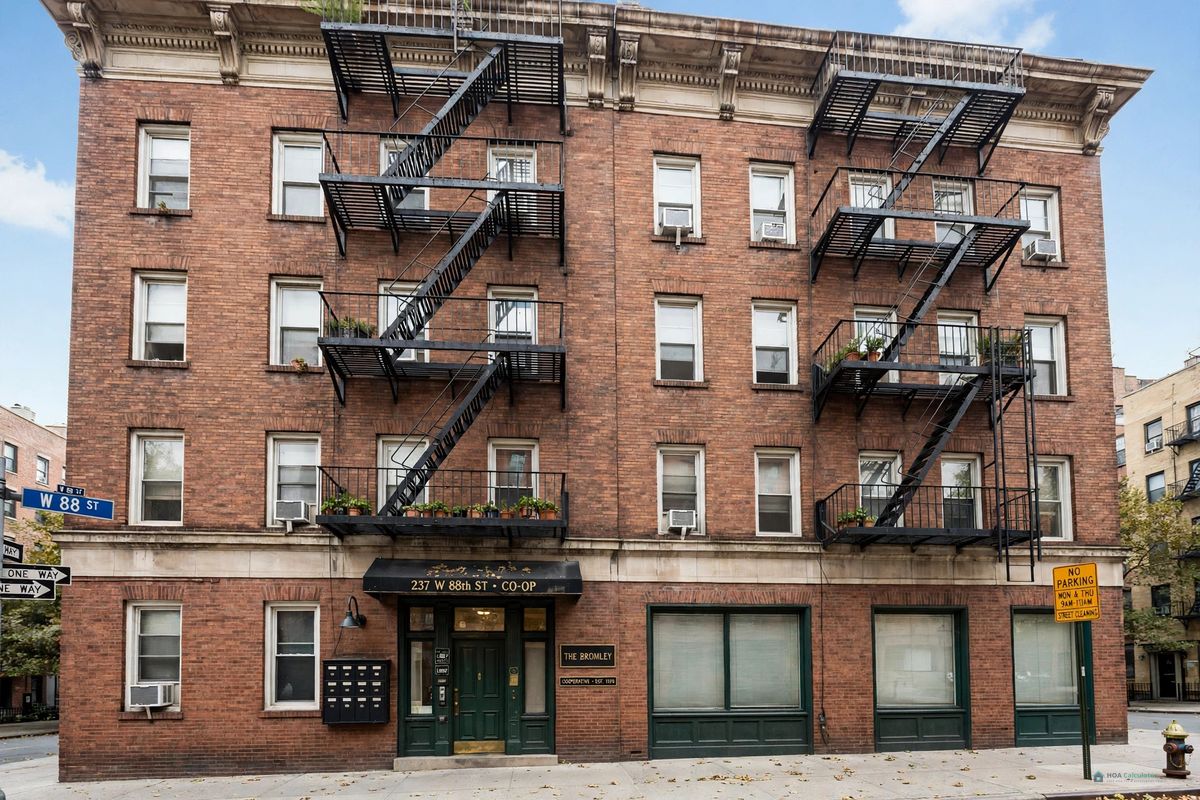
The District of Columbia has about 126,951 owner-occupied households in the Census Bureau's ACS 2025, of whom 49,359 — 38.9% — pay an HOA or condominium fee. That is one of the highest participation shares in the country, because so much of the District's owned housing sits in condominium and co-operative buildings rather than detached homes. Where most state pages on this site pair Census figures with FCAR association counts, the District figures here are Census counts of fee-paying households.
What drives HOA fees in the District of Columbia
People and parking. A staffed front desk is a six-figure annual payroll before a single repair is made; a garage adds ventilation, lighting, gate machinery and periodic structural concrete work; and the District's large stock of pre-war buildings runs elevators and central heating plants that are costly to insure, maintain and eventually replace. Amenities layered on top — roof decks, gyms, pools in the newest Navy Yard and NoMa towers — push the top of the range higher still.
How to read these numbers
Two different numbers on this page answer two different questions. The districtwide median — $490 per month — is the middle figure among all District owner households that pay an HOA or condominium fee, from the U.S. Census Bureau's American Community Survey 2025 (Table B25143), with a margin of error of ±$42. Half of fee-paying owners pay less and half pay more. The neighbourhood table above answers the second question — what buildings in the District's best-known neighbourhoods typically charge — which is why those ranges sit around and above the districtwide median. Legal summaries are drawn from the official statute text cited in the Laws & Regulations section above and are general information, not legal advice. Figures are reviewed when new Census editions are published.
If you are comparing a specific DC building, the association's own budget and reserve study — which you are entitled to review before buying — always override any districtwide figure.
Before you buy: Before you buy in the District, one protection is worth knowing: the § 42-1904.11 resale packet must disclose the unit's account and the association's budget, and you hold a cancellation window after receiving it. A building that cannot produce a current budget or reserve information is telling you something important.
District of Columbia HOA Frequently Asked Questions
The median HOA or condominium fee actually paid in the District of Columbia is $490 per month (U.S. Census Bureau, ACS 2025). That is the second-highest figure in the country after New York, and it reflects a housing stock dominated by condominium and co-operative buildings rather than single-family subdivisions. Full-service buildings with desk staff, parking and amenities routinely charge $600 to $1,000 or more.
There is no single comprehensive DC homeowners association act. Condominiums are governed by the District of Columbia Condominium Act (D.C. Code §§ 42-1901.01 et seq.). Homeowners associations in planned communities are governed mainly by their recorded declaration and bylaws, and most are incorporated under the DC Nonprofit Corporation Act. The practical result: in a DC HOA, the declaration is effectively the law of the community — read it before you buy.
Yes. Under the Condominium Act (§ 42-1903.13), a condominium association has a statutory lien for unpaid assessments, and the most recent six months of assessments carry priority ahead of a first mortgage — which is why lenders watch condo arrears closely. The association may foreclose that lien. Owners receive notice and can cure by paying the arrears.
On resale, the seller must furnish the purchaser with a statement of the unit's account and the association's governing documents under § 42-1904.11 of the Condominium Act, and the purchaser has a statutory window to cancel after receiving them. Associations may charge a reasonable fee for preparing the packet. Buyers should study the budget, reserve position and any pending special assessments in that packet before the cancellation window closes.
Three drivers: people, parking and plant. Staffed buildings pay for front-desk coverage, engineers and porters around the clock; garages require ventilation, lighting and structural upkeep; and older DC buildings carry elevators and central heating plants that are expensive to insure and replace. In the Census data, 18.9% of DC owner households pay $500 or more per month — a share only Hawaii exceeds among the jurisdictions tracked on this site.
Need a Full Property Budget?
Compare multiple properties side-by-side or calculate complex inflation-adjusted lifetime HOA costs.