
San Francisco, California HOA Fee Calculator 2026
San Francisco runs California's most concentrated condo market. The median HOA fee actually paid inside the city is $586 per month (U.S. Census Bureau, ACS 2025, ±$43); across the wider San Francisco–Oakland metro it is $333 (±$15), and the California state median is $272. Only 31 percent of city owner households pay a fee at all — but those who do are buying into small, old, labour-intensive buildings where a single elevator or a balcony repair lands on a handful of owners.
Average HOA Fees in San Francisco by Neighborhood Type
| Property Type | Average Monthly Fee | Annual Cost | What's Included |
|---|---|---|---|
| Downtown / SoMa High-Rise Condo | $825/mo | $9,900/yr | Concierge and staff, elevators, amenities floors, master insurance, reserves |
| Established Condo (Pacific Heights, Noe Valley) | $565/mo | $6,780/yr | Elevator, common utilities, garage, reserves |
| Small-Building Condo (2–6 units) | $385/mo | $4,620/yr | Master insurance, common utilities, reserves — no staff, every owner involved |
| TIC Unit (Tenancy-in-Common) | $340/mo | $4,080/yr | Shared building costs under a TIC agreement — not an HOA, see the warning below |
| Townhome-Style Condo (Mission Bay, Parkmerced) | $445/mo | $5,340/yr | Exterior maintenance, landscaping, common insurance, reserves |
What Do HOA Fees Cover in San Francisco?
A San Francisco condo fee covers the association's operating budget: master insurance (earthquake cover is a separate, debated line), elevator and life-safety systems, common utilities, management, and the reserve contribution the Davis-Stirling Act requires associations to study every three years — roofs, exterior painting and waterproofing, asphalt, elevators, balconies. In the city's many small buildings the same categories apply with no staff at all, which concentrates rather than removes cost. TICs are the exception that traps buyers: a tenancy-in-common is not a condominium, its costs are shared under a private agreement and a group or fractional loan, and no HOA fee in the legal sense exists.
What Drives HOA Fees Higher in San Francisco?
Balconies, by law. California's SB 326 requires periodic inspection of elevated exterior elements — balconies, decks, walkways — in condo buildings, and the repairs it surfaces in a city of Victorian and Edwardian conversions are repricing small associations across San Francisco. Second, seismic work: soft-story and foundation programmes sit in reserves or special assessments. Third, insurance, which has repriced older wood-frame buildings hard. Fourth, smallness itself: a $120,000 deck-and-stair programme divided by four units is a life event; divided by four hundred, it is a rounding error — San Francisco has far more of the former.
How Much Are HOA Fees in San Francisco?
Use the medians as brackets — $586 city, $333 metro, $272 state — and then read the building's reserve study, which California law makes unusually informative: it lists each major component, its remaining life and the funding plan. The two San Francisco questions that matter most are the balcony inspection status (was the SB 326 inspection done, and what did it find?) and, in small buildings, who actually runs the place — a four-unit association with no manager and no study is a partnership you have not vetted. Sellers must provide a statutory disclosure package (Civil Code § 4525); read the reserve summary form in it before the contingencies expire.
Are HOA Fees Negotiable in San Francisco?
Dues follow the declaration's allocation and are not negotiable owner by owner. Around a purchase, the negotiables are price, credits for known capital work (a pending balcony programme is the classic San Francisco example), and allocation of announced special assessments. In TIC purchases, negotiation goes deeper — the TIC agreement, loan structure and occupancy rights are the deal, and they are reviewed by attorneys, not agents alone. New-development dues abatements exist here too; price the unit on post-abatement dues.
Do HOA Fees Go Up Every Year?
Yes. Reserve funding discipline under Davis-Stirling, the SB 326 repair pipeline, insurance and the city's labour costs all push one way. A planning assumption of 4 to 6 percent a year fits recent experience in staffed buildings; small buildings move in steps instead — flat for years, then a special assessment when a component fails or an inspection lands. The calculator below models the smooth version; small-building buyers should hold a separate cash reserve for the step version.
California HOA Laws: What San Francisco Buyers Should Know
California community associations are governed by the Davis-Stirling Common Interest Development Act (Civil Code § 4000 et seq.). Its load-bearing provisions: § 5300 and the Annual Budget Report, § 5550's visual inspection and reserve study at least every three years, § 5565's funding disclosure, and § 4525's seller disclosure package. SB 326 added Civil Code § 5551 — inspection of exterior elevated elements in condominium buildings at least every nine years, the first round due by January 1, 2025. Associations hold a lien for unpaid assessments under § 5650, with foreclosure only after statutory thresholds and process. The California state guide covers the statewide picture, and San Jose shows the same statutes at suburban scale.
How to Estimate Your Total Cost of Owning an HOA Home in San Francisco
San Francisco's stack: mortgage, HOA dues, property taxes (Proposition 13 anchors them to your purchase price — a genuine advantage that grows with tenure), and earthquake insurance if you elect it. A $985,000 condo at $565 a month in dues and roughly $1,050 in taxes carries about $1,615 before the mortgage. Use the calculator at 5 percent for a staffed building; for a small building, model 3 percent plus a five-figure assessment somewhere in the decade, because that is how small buildings actually bill.
Calculate Your Future HOA Costs
Use the free HOA Fee Calculator to project this fee over 5 to 30 years — or compare three fee futures side by side with the Scenario Calculator.
How San Francisco compares
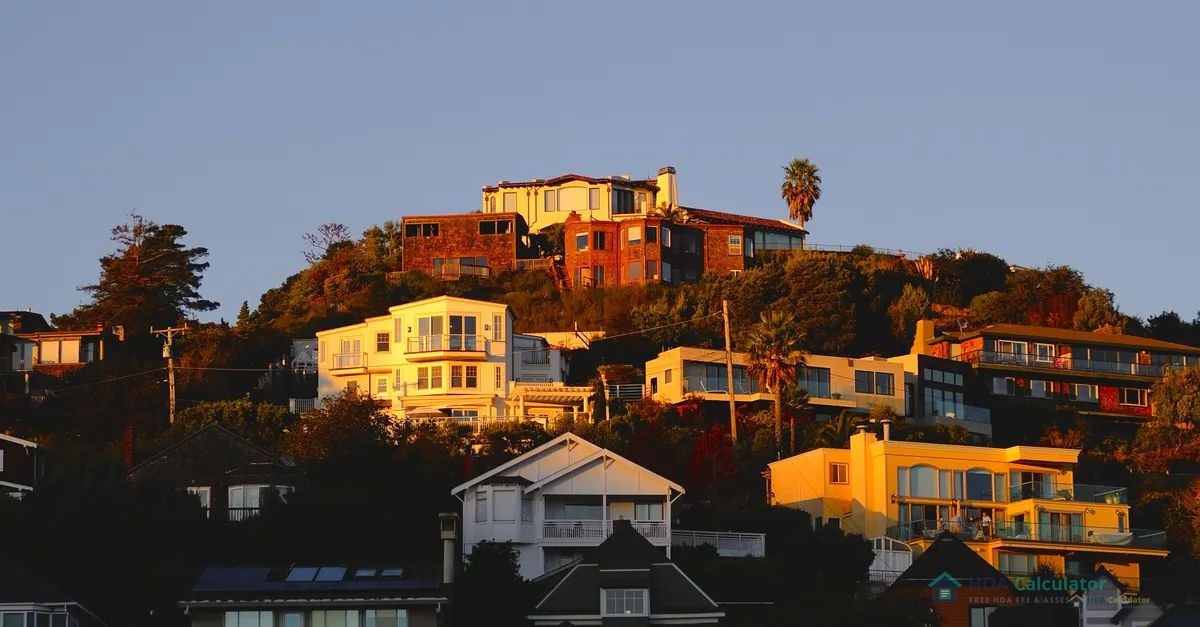
San Francisco's $586 city median (ACS 2025) is the highest city figure in California — above San Jose's $419 city median and the Los Angeles metro's $350, and in national company with Boston ($392 metro) below and New York ($605 metro) above. The metro figure of $333 shows how much of the Bay Area's fee stock sits in lower-cost East Bay and suburban associations.
The structural difference from other expensive markets: San Francisco's cost is concentrated in small buildings rather than towers. That makes due diligence personal — you are not underwriting a professional landlord's balance sheet, you are joining a five-household partnership with a roof.
Frequently Asked Questions (FAQs)
What is the average HOA fee in San Francisco?+
What is SB 326 and why does it raise fees?+
What is the difference between a TIC and a condo in San Francisco?+
What must a San Francisco condo seller disclose about the HOA?+
Can a California HOA foreclose for unpaid dues?+
Looking for Full Multi-Property Comparisons?
Use our advanced homepage comparison engine to pit multiple properties, tax rates, and fee structures against each other.
← Open Home Page Calculator