
Raleigh, North Carolina HOA Fee Calculator 2026
Raleigh may be the most association-saturated big market in America. Across the Raleigh–Cary metro, 57.9 percent of owner households pay an HOA fee — the highest participation share of any large metro on this site — and the median fee actually paid is $79 per month (U.S. Census Bureau, ACS 2025, ±$4). Inside the city of Raleigh the median is $119 (±$16). The Triangle does not have more expensive associations than other growth markets; it has more associations, full stop.
Average HOA Fees in Raleigh by Neighborhood Type
| Property Type | Average Monthly Fee | Annual Cost | What's Included |
|---|---|---|---|
| Downtown / North Hills Condo | $385/mo | $4,620/yr | Elevator, amenities, garage, master insurance, reserves |
| Townhome Association (Brier Creek, Wake Forest) | $235/mo | $2,820/yr | Exterior maintenance, landscaping, community pools |
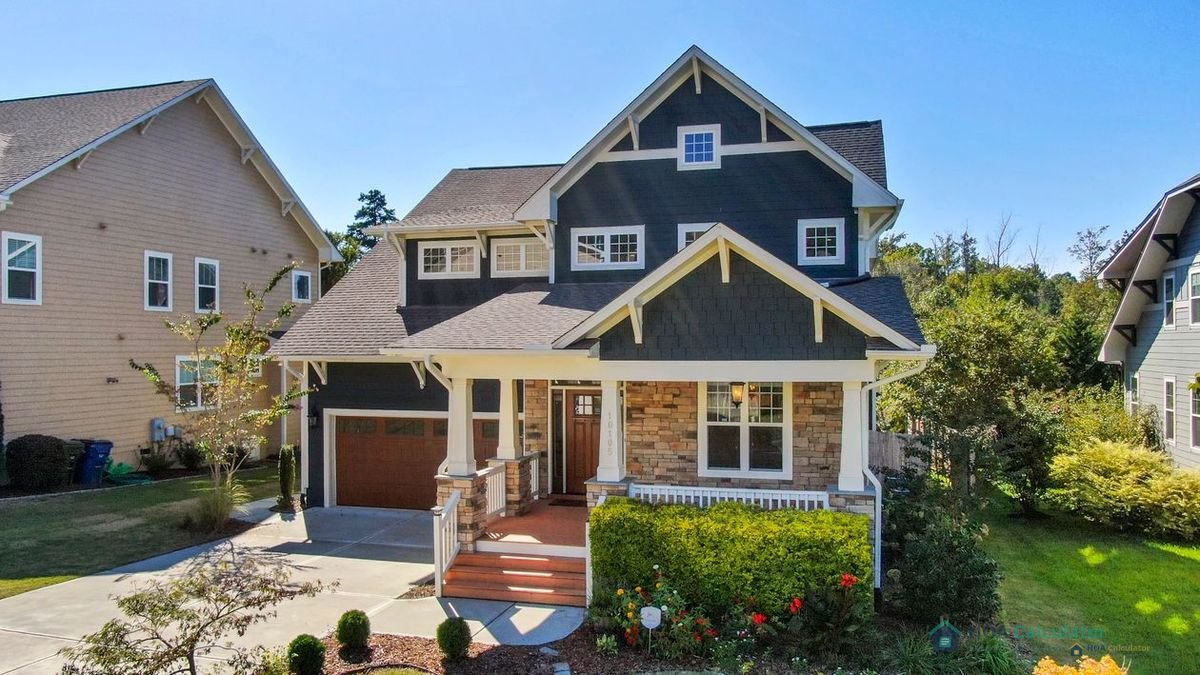
| Master-Planned Single-Family (Cary, Apex) | $95/mo | $1,140/yr | Amenity centres, greenways, pools and swim clubs |
| Established Subdivision HOA | $55/mo | $660/yr | Entrances, common areas, enforcement |
| Active-Adult Community | $165/mo | $1,980/yr | Clubhouse and activities operations, landscaping packages |
What Do HOA Fees Cover in Raleigh?
Raleigh dues buy the Triangle package at every scale: swim clubs and greenway frontage in the master-planned west (Cary, Apex, Holly Springs), amenity centres and events in the new south and east, exterior maintenance in the townhome stock, and the building basket in the small downtown condo sector. North Carolina associations also maintain the stormwater devices — ponds and buffers — that the region's growth rules attach to nearly every subdivision, a recurring cost invisible in the brochure. What dues never cover: interiors, mortgages, and Wake County taxes, which reassess on a cycle that surprises newcomers independently of anything the HOA does.
What Drives HOA Fees Higher in Raleigh?
Growth volume and stormwater. The Triangle adds subdivisions faster than almost any metro in the country, and each arrives with ponds, buffers and amenity centres whose operating costs land in dues from day one. Second, turnover resets in young communities, the standard growth-market pattern. Third, pool and swim-club economics — the region's social infrastructure runs through its swim clubs, and their staffing and resurfacing costs are dues. Fourth, insurance and tree work: the Triangle's canopy is an asset that bills like a liability after every storm season.
How Much Are HOA Fees in Raleigh?
The medians — $79 metro, $119 city, $85 statewide — describe a low-fee, high-participation market. North Carolina hands buyers a specific tool: the Planned Community Act's resale disclosure (§ 47F-4-103, below) requires the association to state dues, balances and planned assessments. Use it, and add two Triangle checks: the stormwater devices on the community's books (pond dredging is the region's classic deferred six-figure item) and the turnover status of any community still wearing its builder's signage. A $95 dues bill in a fully turned-over Cary community is a sturdier number than $95 in a phase-two subdivision.
Are HOA Fees Negotiable in Raleigh?
Dues follow the declaration's allocation; no individual negotiation. Around a Raleigh purchase, negotiation runs through the § 47F-4-103 disclosure: credits for announced special assessments, price adjustments where reserves or stormwater obligations look thin, and allocation of instalments at closing. Builder incentives in new communities — dues holidays, amenity credits — are marketing, and should be priced as such: the post-incentive, post-turnover dues are the figure to underwrite.
Do HOA Fees Go Up Every Year?
Yes, at growth-market rates: 3 to 5 percent in established communities, with steps at turnover and when stormwater or pool capital work lands. North Carolina law requires associations to follow their declarations on increases; many Triangle declarations let boards raise dues a set percentage annually without a vote. The calculator below at 4 percent is a fair central case for this market — and over a 20-year hold it turns today's $95 into roughly $200, which is still cheap, and still worth knowing before you sign.
North Carolina HOA Laws: What Raleigh Buyers Should Know
North Carolina single-family communities are governed by the Planned Community Act (Chapter 47F) and condominiums by the Condominium Act (Chapter 47C). Provisions Raleigh buyers feel: § 47F-4-103's resale disclosure statement; § 47F-3-116's assessment lien, which can be foreclosed in a court-like process after notice; and § 47F-3-102's enumerated association powers. The Acts require associations to keep and share financial records and to follow declaration procedures for budgets and increases. The North Carolina state guide covers the statewide rules, and Charlotte shows the same Acts in the state's other big market.
How to Estimate Your Total Cost of Owning an HOA Home in Raleigh
Raleigh's stack: mortgage, dues, Wake County property taxes (revaluation cycles move this line in jumps — check where your parcel sits in the cycle), and insurance. A $520,000 Apex home with $95 dues and roughly $430 a month in taxes carries about $525 before the mortgage. The dues line is the smallest and the most predictable of the three — model it at 4 percent, spend your diligence energy on the tax cycle and the association's stormwater reserves, and this market will treat you as well as its medians promise.
Calculate Your Future HOA Costs
Use the free HOA Fee Calculator to project this fee over 5 to 30 years — or compare three fee futures side by side with the Scenario Calculator.
How Raleigh compares
Raleigh's $79 metro median (ACS 2025) is the lowest of any large growth metro on this site — under Nashville ($90), Charlotte's metro ($96) and the $85 North Carolina state median — while its 57.9 percent participation share is the highest. The Triangle built its growth through associations so completely that the median fee-payer is an ordinary subdivision household, not a condo owner. Compare Nashville: a similar growth story at $90, with participation still climbing toward Raleigh's level.
For buyers, the consequence is that Raleigh HOA diligence is a volume skill: you will read more declarations here than anywhere else in America, and the differences between a well-run Cary association and a thin one in a phase-two subdivision are worth more than the $40 separating their dues.
Frequently Asked Questions (FAQs)
What is the average HOA fee in Raleigh?+
Why do so many Raleigh homes have HOAs?+
What is the North Carolina Planned Community Act disclosure?+
Can a Raleigh HOA foreclose for unpaid dues?+
What HOA cost surprises Triangle buyers most?+
Looking for Full Multi-Property Comparisons?
Use our advanced homepage comparison engine to pit multiple properties, tax rates, and fee structures against each other.
← Open Home Page Calculator