
HO-6 Loss Assessment Coverage: The $1,000 Default That Leaves Condo Owners Exposed
What is loss assessment coverage?
Loss assessment coverage is the part of your HO-6 condo policy that pays your share when the association bills unit owners for a covered loss — most commonly your slice of the master policy’s deductible, or of damage that exceeds the master policy’s limits. The catch: the standard HO-6 policy includes only $1,000 of loss assessment coverage. With master policy deductibles of $25,000, $50,000, or $100,000-plus now common in coastal buildings, realistic coverage is $10,000 to $50,000 — and $50,000 or more in high-risk coastal towers. Raising the limit is usually inexpensive; discovering the gap after a claim is not.
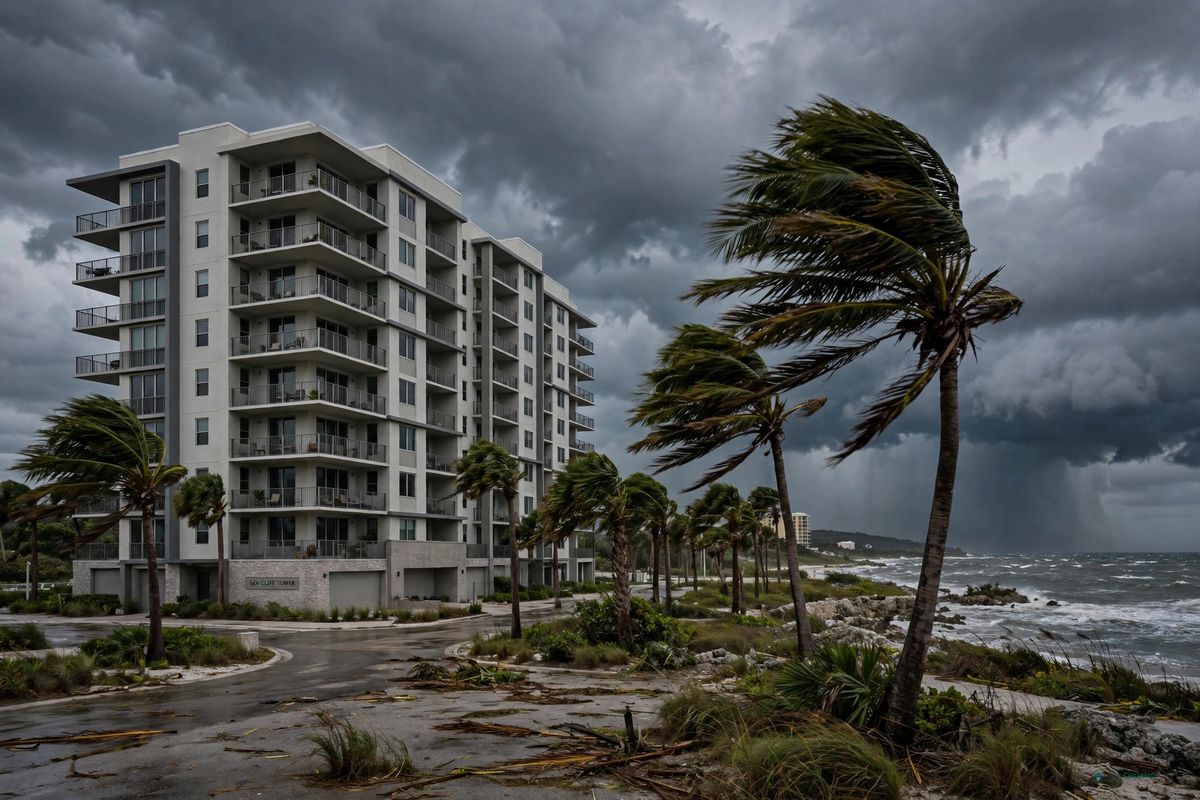
The master policy paid the hurricane claim — mostly. Then every owner in the building got a bill for their share of the deductible, and most discovered their own policy covered $1,000 of it.
Two policies, one building
A condominium is insured in layers. The association’s master policy covers the building structure, common areas, and liability for shared spaces. Your HO-6 policy covers your unit’s interior, your belongings, your liability — and, through loss assessment coverage, your share of certain association-level losses. Owners routinely assume the master policy makes them whole. It does not: it is the association’s policy, with the association’s deductible, and that deductible belongs to the owners collectively.
How a loss assessment reaches your mailbox
Worked example. A storm causes $600,000 of covered damage to a 40-unit building. The master policy carries a $50,000 per-occurrence deductible — unremarkable for a coastal property today. The insurer pays $550,000; the association must produce the other $50,000, and it bills each unit its share: $50,000 divided by 40 units is $1,250 per owner. That bill is a loss assessment.
Now scale it. Percentage deductibles — 2 to 5 percent of building value for named storms in some coastal policies — can push the association’s share into six figures, and assessments follow. Liability judgements against the association that exceed its limits are assessed the same way. The per-owner bill is small in the friendly example and life-changing in the unfriendly one, and the difference is the deductible structure you never asked about.

Why the $1,000 default is a trap
The standard HO-6 form includes $1,000 of loss assessment coverage. That figure dates from an era of small master deductibles, and it has not kept up: with deductibles of $25,000 to $100,000-plus now normal in coastal and high-risk buildings, $1,000 covers a rounding error. Insurers sell higher limits — $10,000, $25,000, $50,000, and beyond — typically for a modest premium increase, because assessments are infrequent. It is some of the cheapest risk transfer in the entire policy.
Before you set your limit, find your building’s actual deductible: it is item three on our HOA documents checklist — the master insurance certificate is one of the four documents every buyer should audit.
How much coverage should you carry?
- Get the master policy’s deductible from the certificate of insurance — the per-occurrence figure and any separate wind or named-storm deductible.
- Divide the largest deductible by the number of units to get your minimum plausible assessment; carry at least that, rounded up to the next limit tier.
- In coastal or high-rise buildings, or anywhere with a percentage deductible, $50,000 is a sensible floor.
- Check whether your policy’s loss assessment coverage applies to deductibles specifically — some forms limit or exclude the deductible buy-back without an endorsement.
- Review the limit whenever the master policy renews; deductibles have been rising at renewal even when premiums make the headlines.
Frequently Asked Questions
Q: Does loss assessment coverage pay for special assessments?
Only assessments that result from a covered cause of loss — for example, your share of a master policy deductible after storm damage, or of a liability claim. It does not pay maintenance special assessments for roofs, elevators, or reserves. The trigger is a covered claim, not the assessment itself.
Q: How much does it cost to raise my loss assessment limit from $1,000 to $50,000?
Prices vary by insurer and state, but increases are typically modest — often a few dollars a month — because loss assessments are relatively infrequent. Ask your agent for quotes at $10,000, $25,000, and $50,000 and compare; the jump from the $1,000 default is the important step.
Q: What if the assessment is for the master policy deductible — is that covered?
Usually yes, if the underlying loss is a covered peril under your HO-6 and your policy includes deductible assessments — but some policies cap the amount payable toward the association’s deductible or require a specific endorsement. Read that clause before you need it, not after the bill arrives.
Q: I own a house in an HOA, not a condo. Does this apply to me?
A standard homeowner’s (HO-3) policy also includes a small loss assessment coverage — typically $1,000 — and higher limits can usually be added. Single-family HOAs carry smaller master policies than condo towers, so exposures are usually lower, but liability assessments do happen.
📊 Calculate Your HOA Costs
Use our free HOA Fee Calculator to estimate your true lifetime HOA expenses — with year-by-year breakdown.
Calculate Now →